
Continuemos o estudo, com a leitura e comentário de mais uma citação de O Descortinar da Alta Magia, de Daniel Mastral:
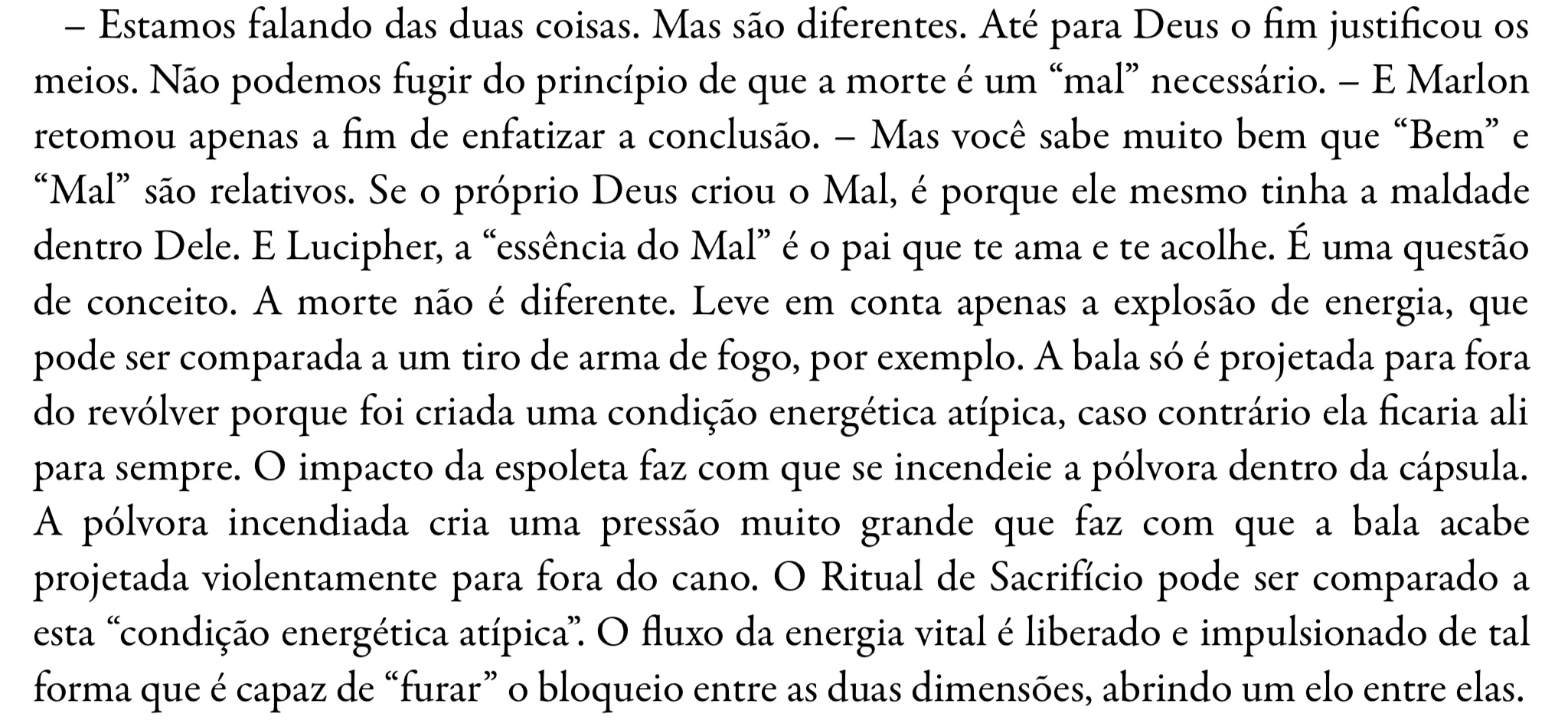
Aqui já estamos no pleno domínio da Abominação que confunde as coisas de Deus com as coisas dos homens e dos demônios. Façamos os esclarecimentos necessários, aproveitando a ocasião para destacar a distinção da santidade de Deus perante a miséria das criaturas, especialmente a das que são desobedientes.
Para começar, Deus não justifica os meios pelos fins, em nenhum momento, e esta crença é indigna do Criador. O que existe, da parte da criatura, é a confusão entre a sua própria ignorância da excelência da Obra divina, mesmo na escolha dos meios, e uma suposta arbitrariedade que violasse a integridade da Justiça divina.
Em segundo lugar, a morte não pode ser um “mal necessário”, desde que está escrito, por exemplo, que “Eu não tenho prazer na morte de quem quer que seja“, e também que “o salário do pecado é a morte“, etc. A aceitação da morte como parte de uma natureza compõe a cultura de normalização da mistura de luz e trevas, exatamente o oposto do Discernimento e da Obra de Separação. Foram as decisões dos nossos antepassados, e as da nossa raça até hoje, que causaram e continuam causando a morte. Apenas por um aspecto isto já fica claro: quem não reproduz o Pecado Original, isto é, o Pacto Ouroboros, não contribui para a perpetuação da morte.
Em terceiro lugar, Bem e Mal não são relativos, os nossos conhecimentos do Bem e do Mal é que são relativos à limitação da nossa forma substancial, isto é, não podemos conhecer a verdade plena como só Deus pode. Por isso às vezes as coisas parecem ser de um modo agora, ou de outro modo noutro momento, ou para uma pessoa e então para a outra, etc.
Em quarto lugar, o Mal não foi criado por Deus, a Liberdade é que foi criada e, para que ela fosse real, a possibilidade do Mal sempre teve de ser igualmente real, como mera potência, para a efetividade da liberdade dos contingentes.
Em quinto lugar, todo o resto do argumento, baseado num raciocínio de causalidade eficiente, já é uma redução das qualidades formais e teleológicas que constituem o valor espiritual da liberdade humana, e sendo assim é completamente desprezível. Pode-se afirmar que os espíritos infernais agem de acordo com as leis dessa causalidade, mas isso somente depois da condicional legalidade das suas petições junto ao Altíssimo, que por sua vez requerem a confirmação dos mais importantes subsídios espirituais, especialmente o assentimento da liberdade humana. É o arbítrio humano que está em disputa, e não o controle dos instrumentos da ação posterior à permissão divina.
Como se vê, a extensão da correção de uma compacta coleção de mentiras precisa ter o dobro ou o triplo do volume que ela mesma ocupou. Mas tudo isso será devidamente vingado, mais dia, menos dia.
 JESUS É BOM
Religious rhetoric sucks. Fear of Heaven refers to a person who strives to protect his Good Name Reputation. Its known as “Baal Shem Tov”.
The Av time oriented commandment of t’shuva
K’vanna of the High Holy Days: Breathing the Live Spirits of the Avot. The Resurrection of the Dead. The k’vanna of the second blessing in the Shemone Esrei. High Holy Days – T’shuva for tumah middot as opposed to prophetic mussar defined tohor middot.
A K’vanna of the High Holy Days. The k’vanna of the 2nd blessing of the Shemone Esrei. The Divine Presence Spirit Name simply not a word that fools who translated the Xtian bible and Muslim koran can translate to other words. Attempts to translate the Divine Presence Spirit Name to other words defines the sin of the Golden Calf throughout the Ages. Never once does the Xtian bible or Muslim koran ever bring the Spirit Name revealed in the first Sinai commandment Name. To understand the Shemone Esrei tefillah required to discern the distinction which separates the Av from the Toldoth: Kre’a Shma from Tefillat Shemone Esrei.
The word אדוני a word which the lips of Man can frame and pronounce. This Hebrew word functionally means “הבדלה”. In the 2nd blessing of the Shemone Esri a basic הבדלה separates the living from the dead. The former breath live spirits, while the latter does not. Words spoken do not equal to the spirit of life that breaths and causes the soul of man to live.
This fundamental הבדלה separates the Divine Presence Brit Spirits of the Avot: Avraham Yitzak and Yaacov. Blowing the Spirit of אדוני requires Oral Torah wisdom. When a sage breathes the Divine Presence Spirits his Spirit Soul becomes “ONE” (think kre’a shma) with the living Spirit Souls of the Avot. Hence breathing these Spirit Souls quickens the lives of the Avot and they live as resurrected from the dead in all generations of bnai brit Israel who breath the Divine Spirit Name and do not kiss the Golden Calf of worshipping words which attempt to pronounce the Name revealed at Sinai as words.
The Spirit Name has 3 parts: One affixes with the oath brit sworn at Gilgal – the Rashi tefillen. The Second affixes with the oath brit sworn at Sh’Cem – the Rabbeinu Tam tefillen.
The Third affixes to הדבר דבלב, a matter of the heart. Herein defines the k’vanna of dav’ning tefillah as opposed and contrasted by saying T’hillem prayers.
The last Parshah of ויקרא inverses the Order of the Avot like as does the Shabbat Mussof Amidah inverses the Order of the Hebrew Alphabet. The Order of the Shemone Esrei affixes 3 blessings at the beginning and 3 blessing at the conclusion. The k’vanna how to blow the spirits of the Avot inverses just like as learned from the closing Parshah of ויקרא. Herein defines the k’vanna of spirits blown in the Shabbat Shemone Esrei and its inverse Order blown during the Musof Amidah. The same equally defines the opposing k’vannot between the Yom Kippur Amida of minchah and Neilah tefillah. כלל: The morning and afternoon tefillot always affix to the two kre’a sha wherein a person accepts the blessings and curses of the Torah.
Hebrew: ש (shin) corresponds to the sound “sh.” Aramaic: ד (dalet) is used for the same sound. This interchange is part of the historical evolution of both languages. The Middah spirit אל directly refers to יום הזכרון. The Divine Name האל by contrast affixes with the שם מ”ב at the end of korbonot. The k’vanna to uproot avoda zarah from within the heart of bnai brit Israel. The interpretation of the word ישראל: servant of אל. Just as a mitzva never to forget that HaShem judged the Gods of Egypt to liberate Israel from slavery; so too a similar mitzva never to forget the tumah of the sin of the Golden Calf.